
Despite myself, I sometimes find myself longing to believe in the afterlife. The past three days have been such a time.
Since November 19, 2026, when the International Court of Justice ruled that Myanmar committed genocide against its Rohingya Muslim minority in Rakhine State—the first time the UN’s top court has held a state responsible for genocide under the 1948 Genocide Convention—I’ve been longing to believe Mohib Ullah [Mohammed] is sentient in his afterlife.
He’s seen the ruling and is now looking down at his family in the Kutupalong refugee camps, at his friends and neighbors who he fought for, and at me too. Looking down and smiling from somewhere in the ether above us all.
After all the conversations we’d had, after all the steely hopes, broken sighs, and intense frowns he’d laid bare to me — way more than he did with many other journalists; after his murder by pretend jihadist sellouts from his own refugee camp — I’ve lived a silent grief. One you might even call unbecoming of a professional reporter expected to stay unsentimental, unattached and objective. But a grief beyond my ability to detach from or stay unaffected by.
The grief has played out in one simple recurring visual — me looking into Mohib’s solemn eyes and saying a silent ‘sorry’ on behalf of humanity that failed him and his people — the Rohingya.
Sorry because despite mouthing big words of freedom and liberty from the West, brotherhood from the Middle East, democracy from India, and growth from China—we were too small to do right by Mohib and his dream of peace and dignity.
Too small and too weak to stand up to relentless and remorseless enormity of what the Myanmarese junta, the thugs of the Tatmadaw, and the elite Nobel laureate enabler of the genocide Aung San Suu Kyi did to the Rohingya.
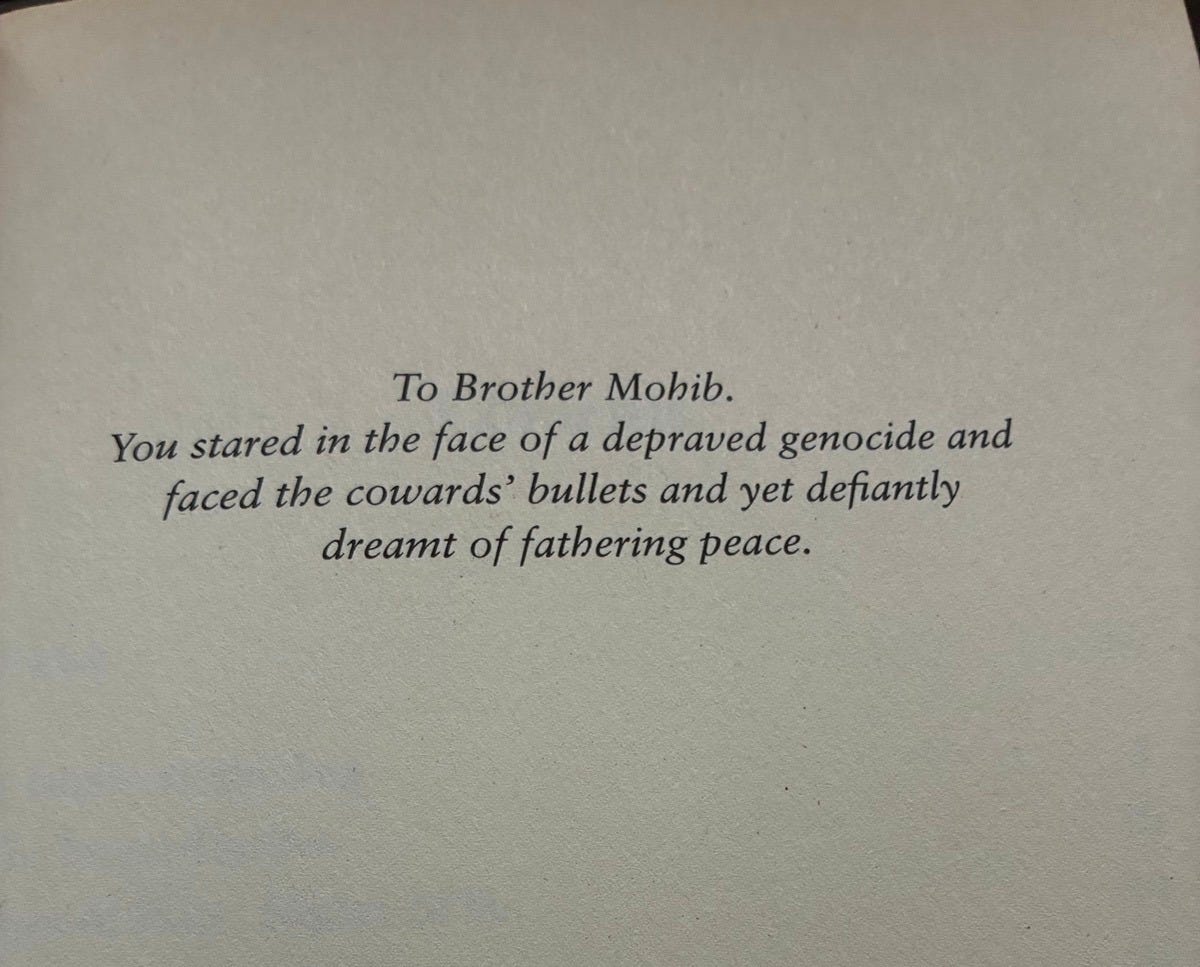
That I dedicated my book The Company of Violent Men to Mohib, was but an admission of the grief and guilt I felt at having walked away from the quagmire of human indignity which the Rohingya were drowning in the refugee camps of South Bangladesh. Walked away saying “my job as a reporter is done — what more can I do?”.
Now that Gambia — the smallest nation in mainland Africa — has stood up to the mighty narco-state and their monstrous network of allies. Now that Gambia has done what we the citizens of big strong countries with meg≠couldn’t compel our even bigger and stronger governments to do. Now that there is recognition of the genocide on record. Now that there is at least a glimmer of hope that the Rohingya who live on might have a shot at freedom, liberty, and above all: basic human dignity.
It’s only now that the visual that’s run all these years in my mind’s eye has shifted. Shifted and softened into these wishful thoughts of seeing the face of Brother Mohib smiling in his afterlife.
The genocide of the Rohingya has more than amply been recorded by the press around the world. I have written some dispatches from the camps too. Much is being written now about the ICJ ruling as well.
Neither do I have any news records or statistics to add at the moment, nor am I in the state of mind needed to do so.
So let me just share with you an excerpt from my book which recounts some interactions I had with Mohib and his fellow Rohingyas in the camps of Bangladesh.
It remains — in purely my subjective and uncertain ways — that set of words I’ve penned which most accurately represents what I saw and felt.
Excerpt: Shaa, Shuari and a Hot Meal of Rice
I had run into Shaheen three days before the end of my stay in Kutupalong—the largest camp in the cluster of Rohingya refugee camps in Cox’s Bazar, Bangladesh. And the ‘running into’ was hardly metaphorical. The nine-year-old girl almost got crushed under the wheels of my car.
The morning had begun earlier than usual, and the previous night had ended late. I’d slipped into an exhausted slumber within a minute or two of leaving the hotel.
‘Sir . . . sir . . . wake up . . . they need IDs . . .’ I woke up to Abu, softly nudging me.
Abu—my young, saturnine driver turned ad hoc translator and guide—had let me sleep until we were at the main gate.
‘They’ were the black fatigue clad paramilitary personnel of the Rapid Action Battalion hovering around the gate, asking visitors who they were, why they were visiting and how long they would stay for the day.
With the ID check done and having returned the ever-so- slight but friendly nod from the officer who’d seen me almost every day, I was fumbling to get my camera assembled and the mic attached on my phone. There was no time to waste.
And right then, it happened.
Abu slammed the brakes, the car bumper hit the dirt road, and dust flew up. Lenses, battery and mic spilled onto the dashboard. Abu let out a string of Chittagonian swear words, mixed with him slamming the horn down, a clamour from bystanders and a burning pain in my left shoulder where the locked seat belt’s edges cut into my skin through the shirt.
The reason for all this commotion was Shaheen.
Wearing a dress frayed at the edges, with lily-like flowers imprinted on it but faded beyond an identifiable colour, she stood well under four feet tall. Perfectly trimmed bangs of jet black hair threw her fair face and impish smile into relief.
Hugging a whole carp in a transparent cellophane bag to her chest, she had blindly run into the car’s path, halted for a fraction of a moment, then bolted to the other side.
Abu opened the door and made a start for Shaheen, shouting at her for being a stupid, careless girl. But we managed to catch only a glimpse of her when she paused for another moment, looking back at the mess she’d caused, before disappearing into the maze of tarpaulin covered thatch houses.
It was all so quick. Neither Abu nor I could have possibly followed her. Besides, what would I do if I had caught up with her? Given a lesson in the virtues of road safety to a genocide survivor?
‘Let it be,’ I told Abu, reminding him we had more important things to do and didn’t need a near-accident holding us back.
Abu parked his car under a tree not far from the chowk and, while he caught up on lost sleep, I walked into the camp with Ilyas—my Rohingya translator—west of the chowk, down the mud road that led to Mohibullah Mohammed’s thatched home. Mohibullah was the chief organizer of the Arakan Rohingya Society for Peace and Human Rights, a spin-off from the Arakan Rohingya National Organization. He had taken on the monicker ‘Peace Father’ and become the most prominent face of repatriation demands inside the camp. He was one of the first people I’d interviewed.
Soon, the daily reporting routine took over—interviews with the refugees about life in the camps, profiling of lives before the genocide, scanning of documents that testified to how the social standing and education of regular self-respecting humans had been tossed into pyres lit by the Burmese military and so on and so forth.
This continued until around noon when the women sent their children to remind the menfolk that it was lunchtime and they were waiting.
‘Come join us,’ Mohibullah and his comrades said warmly.
As always, the Rohingyas invited me to share their meal of dal and rice, made from the meagre rations handed out by the aid agencies. As always, I politely refused.
‘You carry on, I have some more work to finish. I’ll see you post lunch.’
From the very early years of journalism, keeping an emotional distance from those we report about had been drilled in by seniors. It’s a good rule to follow. Especially when building dikes against an enormity of proportions like the Rohingya genocide. Breaking bread with the subjects one is reporting on is antithetical to that keeping of distances.
Besides, I had very little time left in the camps and needed to use all the hours I had there to report as much as possible. Being friends or eating meals wasn’t going to pay my bills.
In short, it was a day like the many others I’d spent in the camp, except for one thing—Shaheen.
‘Can you find out where that girl from the morning lives?’ I asked Abu, returning to the chowk. ‘Don’t say anything to her or her family. I’ll finish my photographing and see you in an hour or so.’
‘Sir . . . do you need me [to come along]?’ Ilyas asked. He knew I’d say no. And I did.
‘Take a break—I’ll have Abu call you if I need you.’
A little over an hour and a half later, I circled back to the chowk. Abu hadn’t arrived. And since my phone didn’t work in the camp, I had no way to contact him.
I sat down on the edge of a bench outside the camp’s ‘restaurant’ and lit my last cigarette. In the rush of the morning, I’d forgotten to restock.
The restaurant was just a larger version of the bamboo, mat and tarpaulin thatches that the Rohingyas live in. Unpolished wooden planks made for both long tables and seats.
The place served food to the manual labourers and security who worked in the camp. People like me—reporters, aid workers and similar hordes of distress tourists—didn’t go there. So I caused a small commotion by sitting down.
The bespectacled man who ran the cash counter barked at the last of the lunching labourers to make room for ‘Sir’, and the dishwasher came running with a rag to wipe a table for me. I motioned and grunted, indicating I wasn’t going to order and was just resting my tired legs for a bit, and they needn’t bother.
Half an hour or so later, with Abu still nowhere in sight and me having run out of my regular cigarettes, I bought a packet of the local brand a guy on the other side of the road was selling. The hard smoke went down like a beast clawing against the insides of my throat, and I asked for tea to soothe the pain.
By then, the lunch crowd was petering out, and the mud roads were emptying. Siesta time had set in.
The starch drained from rice pots and the leftovers of dal and potatoes in the dirty plates piled up next to the eatery had begun to rot. The stench had started roiling up in the afternoon heat.
Hot with the April sun, the wind raised little dust devils on the mud road. As the fine silt washed over me, the cashier tied currency notes in bundles with rubber bands, the dishwasher snoozed on an unoccupied bench, and the cook ground an uncovered aluminium pot full of raw lentil paste in a grimy blender. The lentil paste, mixed with salt, garlic paste, fennel seeds and chopped onions, would be transformed into deep- fried pakoras served with tea and muri (rice pops) seasoned with mustard oil and green chillies for the evening tiffin.
I saw all these things, but my mind kept returning to Shaheen.
As the episode of the morning played out in my mind’s eye in slow, halting motion, I saw the little girl again. The hair, the dress, the carp. The running, stopping, running again. The little pause, the smile and the bolting off after.
Her face was clear in my head, looking back at me with a sweet, innocent smile. One I never will or ever want to forget. In fact, five years later, as I write these lines, I’m smiling back at her.
Through that smile, she had apologized for being careless and for the mess she’d caused the adults and their serious business with her silly antics. But she’d been so full of joy, there was very little of her already little self that she could have spared for any other emotion. And the carp had something to do with that joy.
‘Another tea, sir?’ the cashier asked, breaking my stupor.
‘Sure,’ I said. I didn’t say no to another round of tea very often. Besides, I was occupying space at his place of business, so I might as well bill a few takas.
The sun was hovering barely a few feet above the edge of the camp by then. Rising from their siestas, the Rohingyas had started milling around the chowk. A crowd was gathering around the cigarette wallah who’d sold me the horrible tasting cigarettes. He, too, set a tea kettle on the boil on a kerosene stove.
Vegetable vendors had come in and set their stuff on rags laid out on the ground. I’d seen these evening markets before. Bottle gourd vines, water spinach, green chillies, onions and potatoes—only the basic cheap stuff the Rohingya could afford.
‘Stop inviting sir to eat with us,’ Ilyas had ribbed Mohibullah some days back. ‘What will you feed him? All we eat every day is that damned rice and dal.’
‘Siddharth bhai is one of us, no?’ Rohim—a member of Mohibullah’s team—had retorted. ‘He loves his tobacco and tea just like a Rohingya. And Rohingyas eat rice no matter which meal it is!’
‘Speak for yourself,’ Ilyas cackled and, holding Rohim’s tummy in a pinch, added, ‘The rice is all settling here for you! Eat some dal too—you’ll get some protein, you oaf.’
Proteins, other than what was in their watery lentils, were hard to come by. Neither was there much of a supply of meat and fish; nor did the Rohingya have the money to buy them regularly. Vegetables were the aforementioned vines and leaves, with only an occasional addition of a gourd here or a tuber there.
The only edibles in abundance in the camp were betel leaves and areca nuts.
Bangladesh, in general, and Cox’s Bazar, in particular, grows a lot of these. In fact, the entire marine road going from the city to the camps is lined with betel farms and houses shrouded in groves of areca palms that sway in the sea breeze.
Local Bengali villagers come into the camps every evening with sackfuls of the lush green, pungent paan and the woody, bitter brown nuts the Rohingya call shuari. As the produce is local, the freshness is unsurpassed and the prices are low. Needless to say, the Rohingya make the most of this, and business is brisk. Men and women alike, it’s hard to find a Rohingya whose face isn’t stuffed at all times with the blood-red mush of paan-shuari-tobacco.
The Rohingya make a big fuss going to these evening markets.
There is an entire ritual—the putting on of clean clothes, the connoisseur-like checking of quality, the seeking of assurances from vendors that these won’t be as bad as the last lot, and the vendors, in turn, doling out hyperboles like: ‘If you get anything better than this at this price in this market—I swear on my dead father and Allah—I’ll stop this business tomorrow!’
A joyous farce enacted every day for a few hours, these evenings let the Rohingyas live the mores of what quotidian life was in a land they, not long ago, called home. It is a time where, under the shroud of growing twilight, they can hide from the stark reality that life is nothing like it used to be or will ever be again.
‘You know what a Rohingya really wants?’ Korim, Mohibullah’s lieutenant, asked me one day, grinning and baring his red-stained teeth.
It was another afternoon, and we’d had a long day of intense conversations about what the Rohingyas’ demands were. Mohibullah had painstakingly taken me through the many treaties and agreements with the military junta, the other groups of non-Burmese Arakanese ethnicities who’d rebelled against Rangoon, the joining of forces with Bogyoke Aung San and, subsequently, his daughter Aung San Suu Kyi to demand democracy, establishing the many times the Rohingya had asked for and been granted autonomy and the right to self-determination.
The conversations had tired us all out, and we were taking a break with lemon tea—shaa, as they call it. The tea had very little sugar because very little was given to them. The salinity of the hard, brackish groundwater the Rohingyas drank and cooked in gave the tea a strange taste. The men had set forth some betel leaves, too, but I’d only taken some bits of the areca nut from the mixture.
‘What a Rohingya really wants . . .’ Korim continued, ‘. . . is to have his shaa, shuari and a hot meal of rice. In peace!’
It was almost sundown, and I was still waiting at the restaurant when a little boy, younger than Shaheen, walked across the chowk, dangling a live chicken upside down by one leg. At least one Rohingya family was going to have a non- basic dinner tonight. I took a photo of him from behind. He turned at the sound of the click, grinned, silly and shy, and promptly ran home just as Shaheen had done.
The cook brought me another tea and a plate of pakoras with it.
‘No, no . . . no pakoras,’ I said.
‘No money, sir . . . just for tasting,’ the cashier grinned and said from behind his counter. On cue, the cook grinned as well.
‘Thank you,’ I said and put one in my mouth. After a convincing number of chews, I lied, ‘Very nice!’
The lentil was gluey and undercooked on the inside, and the outside had been fried to a rock. Coarse salt had been used instead of the powdered kind, and it sat in clumps of bitter salinity arriving unannounced in sudden shocks inside an otherwise insipid cud. Moreover, the oil used was as thick as engine grease and burnt beyond fitness for human consumption from repeated use.
But to make my lie convincing and honour the shopkeepers’ kind gesture, I managed a few more bites and made expressions of satiety and hummed appreciation.
‘Sir . . .’ Abu had returned. Without saying anything more, he gave me and the pakora plate a look that said, ‘Really?’
Refusing my enthusiastic offer to partake of the dal pakoras and handing me a bottle of water, he said, ‘I found the girl.’
After five-odd minutes and some untraceable turns in the camp’s maze, I reached the thatch house Shaheen called home.
Her mother—who appeared to be in her early thirties, with a face whose beauty hadn’t yet been beaten out by the hard camp life—clasped her hands at her chest and let out a string of Rohingya as soon as she saw me.
‘She’s saying she’s very sorry for what her daughter did,’ Abu translated as the woman spoke. Abu wasn’t as good as Ilyas, but would do for now.
‘It’s okay, it’s okay,’ I tried calming the woman down. But she went on with her loud apologies. Hearing the commotion, her neighbours came out. This was becoming a scene I didn’t want to be in.
‘Where’s your daughter?’ I asked. Fishing out a clutch of sweets from my bag, I said, ‘Here . . . these are for her. Tell her I’m sorry about this morning. We are sorry. For scaring her.’
Abu looked me in the face, reluctant to translate. But then did as he was asked.
In my line of work, where cigarettes don’t work, sugar does the trick with strangers who need disarming. Toffees and lozenges are always to be found in my bag.
In fact, from the second day that I set foot in the Rohingya camp, Mohibullah’s daughter, Afnan, had made me triple my daily stock. Mohibullah, in addition to introducing many of his fellow activists, scholars and contacts in other parts of the world, had introduced me to his daughter Afnan—his ninth-born.
Not that he had planned to. But when Afnan just strolled into our meeting and sat down in the middle, he had no option but to.
Afnan had Down’s Syndrome and couldn’t speak. But we took to each other from the very first time we met. Well, to be honest, she took to my camera more than me.
Afnan had not only unabashedly walked into a meeting of august adults, but she also sat down right in the middle, paying no heed to her father’s requests that she leave. Neither I nor any other adult in the group minded Afnan’s presence, so Mohibullah gave up trying to get her to leave and resumed his conversations with me.
Barely a minute or two into the conversation, Afnan started poking her father in the leg. After ignoring her for a bit, ‘What?’ he asked, exasperated.
She pointed at my camera and, grinning, looked from her father’s face to mine.
‘No!’ her father refused sternly. But the very moment we started talking, she resumed her poke-n-point routine. All the while smiling her potently disarming smile.
‘You want a photo?’ I spoke to her directly—miming the taking of a photo to bridge the language gap. The offer turned the smile into an incredibly silly grin, and her cheeks blushed hard enough to look like a crimson burn. She shook her head, saying, ‘No . . . it’s okay,’ but a moment later put on a pair of dark glasses and posed.
The adults gathered, abandoning talks of genocide and world politics, burst out laughing.
Of course, I took her photo. And to seal our nascent friendship, I fished out a few mints from my bag and gave them to the girl. She put one in her mouth and the rest inside her T-shirt, where they settled like little pebbles around her tummy at the place where she had tucked her top into her fraying skirt.
To this day, I don’t know how, but even though Afnan never left the room, the news of this exchange of mints spread through the ether. Within a few minutes of the act, half a dozen of Afnan’s friends appeared one after another.
From the next day, I became the guy who brought sweets and let kids take photos with his camera. A reputation I made sure never got dented till the last day by tripling my sugary stocks.
The offering of sweets convinced Shaheen’s mother I wasn’t there to admonish her or her daughter, and she calmed down. Her face went from pained apologies to a smile and, looking into the darkness of their damp thatch, she called out to her daughter by name.
After two and a half calls, the face I’d seen in the morning peeked out from behind a braided palm leaves partition. Then, on seeing the sweets, the smile from the morning appeared too. And she stepped out.
‘She’s always loved eating fish,’ Shaheen’s mother said. We were seated on a plastic mat with UNHCR woven into it. ‘She’s been begging me to buy her some fish for months. Today’s the first time we’re making it in the camp.’
They hailed from Maungdaw Township—close to the Bangla–Myanmar border. The family of four was well-to-do by Arakanese standards.
‘He (Shaheen’s father) was the only son, and we had a good farming business,’ the woman narrated. ‘I am a graduate, and after marriage, I’d completed my training as a beautician. My husband rented me a shop, and I started a ladies’ parlour. It was all going well. Shaheen was born in 2011, and then my son in 2014. And now I’ve been in the camp since 2016. I was in another camp earlier but moved to Kutupalong in 2017.’
‘Where are your husband and son?’ I asked. It was a question that will haunt me for a long time to come.
‘They didn’t make it,’ she said. Looking down at her knees, she went quiet. Shaheen sat still, hiding behind her mother.
‘The Tatmadaw killed them,’ Shaheen’s mother said after a long pause, continuing to look down, sitting still as a statue. Shaheen noiselessly picked at a frayed fibre in the UNHCR mat. Teardrops fell on the woman’s knees, and a patch of wetness gathered on her saree. Then came the sobs and larger teardrops fell on the plastic mat. In the quietude of the evening, they sounded like the wayward raindrops that precede a storm.
‘Those men were so violent and so heartless. Like monsters!’ the woman said of the Tatmadaw. ‘I’d gone to see some relatives in another village with Shaheen. Her father had stayed back with our son. When I came back, I was told they’d locked our house from the outside with my husband and son inside and then set fire to it. We hid in the fields until nightfall. Only after the platoon left did we realize others had been hiding in the fields. We took nothing. Nothing was left to take. I didn’t even dig through the ashes to find my dead husband and son. I just held my daughter’s hand and left.’
Quiet descended in the thatch again. Nothing I had ever read in school or learned on the field had prepared me for asking any follow-up questions or saying anything that made any sense any more. We all sat in silence for I don’t know how long.
‘We should leave, sir . . . the gates will close,’ Abu said in a near whisper, breaking the silence.
‘No, no . . . don’t leave . . . one minute,’ the woman rubbed her eyes clear and, bringing a big, beautiful smile to her face, asked us to wait and rushed into the space behind the partition.
She returned with two plates of rice and fish curry and set them in front of us.
‘Please don’t say no . . . this is the first time we’ve made fish. I don’t have a real kitchen and none of the spices I need so it’s not very good, I know. But please eat a bit.’
I convinced her to take back one plate, and Abu and I shared the other.
The curry was little more than a thin broth of salt and a lot of red chilli powder. But the carp was fresh and lent some umami substance to the curry.
‘I’ve started doing some salon work for the women here now,’ she said, beaming as we ate. ‘Basic things like haircuts, threading and such. Whatever I can manage within these circumstances. And every taka earned is something, right? A madam in the school (run by an aid agency) has said she’ll get me some more stuff like wax strips, scissors and combs.
If I manage to save up, I’ll get a hairdryer too. I should be able to do better with that.’
‘But all my income will probably end up in feeding Shaheen fish curry!’ she laughed. Abu and I laughed with her. Shaheen grinned and once again hid behind her mother’s back.
The next day—my last in the camps and the last but one in Cox’s Bazar—Ilyas met me as usual.
‘Did you go to meet Shaheen’s mother yesterday evening?’ he asked.
Ilyas—the lanky father of two lovely little girls, the second one being born of premature labour when he and his wife were trying to run away from the Tatmadaw—was a street-smart guy with a network of informants in the camp that made him invaluable to reporters like me. So it was no surprise he knew about my evening visit to Shaheen and her mother. He possibly even knew that I’d eaten fish curry and rice at their place and given sweets to Shaheen.
But he had a rotten mouth—and not just literally from the tooth and gum decay that came with his betel, areca and tobacco addiction. He was given to vile gossiping and name- calling behind people’s backs.
‘Rubah, sir . . . these are all rubah . . . not safe after evening,’ he had said the first time he took me around the camp. It had taken me some time to understand that he was calling the villagers around the camp ‘robbers’, claiming they stole things from the refugee camps.
From that point on, I realized that for every one piece of helpful information Ilyas had, he had ten criticisms of everyone around—even Mohibullah.
‘Shameless he is . . . producing so many babies.’ He had said when I asked him about Mohibullah’s family.
‘He’s a complete lout—numskull,’ he said of Korim.
‘That fat woman doesn’t pay well. She doesn’t even look like a woman!’ he’d cackled about a Reuter’s reporter.
‘Yes, I did,’ I said, replying to Ilyas’s question asking if I’d met Shaheen’s mother. ‘Why do you ask?’
‘You didn’t call me before going there? You should have. Not good woman, sir . . . liar also.’
I looked at him questioningly.
‘I know her well, sir,’ he continued. ‘She from Maungdaw, like me.’
Lowering his voice and bringing his foul smelling mouth close to my face, he said, ‘She’s a whore sir. Whore. That’s why the money to be so pretty and do make-up, sir.’
‘My biggest fear is about what we will become here in the camp,’ Mohibullah had told me one day when we were simply talking and not doing any interviews. ‘Refugees don’t remain human, you know. Without basic human dignity and without a place to call home, they become animals after a point. Animals who’ll do whatever just to survive. They’ll fight and bicker over the smallest things.
‘Already factions are forming inside the camp. Factions of people who don’t like me because I talk of peace and want to go the democratic way. Many want to start an armed resistance, you know. They think guns, bombs and jihadist methods are the only way to hit back and assert power. They call me unmanly and spineless and are just waiting for a chance to pick a fight with me.’
Mohib’s fears were proven right. On 29 September 2021, he was gunned down by members of the Arakan Rohingya Salvation Army, a jihadist outfit that swore allegiance to the Islamic State.
Ilyas called me after Mohib’s killing.
‘I’m scared, sir. I’m very scared. Please see if you can get me out,’ he had pleaded.
If this post informed and engaged you, please subscribe and/or support my work with a one time donation. It helps me keep reporting, analyzing, and writing while keeping up my independence from propaganda.